| Hi Wga,
Do you want to live longer and stay healthier?
I think a lot of us do.
But for that, we need to be doing things that reduce our risk of chronic diseases.
Risk reduction is a scale not an on-and-off switch - it's degree-dependent.
I'm going to explain to you something precious.
We've all had a blood test and the results were in the normal reference range.
However, what's in the normal reference range isn't necessarily optimal.
Let me explain...
The "normal" reference range reflects where 95% of the normal population falls into.
The optimal range reflects what's linked to the lowest risk of mortality and chronic diseases.
These two aren't always mutually inclusive.
Being in the "normal" reference range is sometimes already linked to a higher risk of death compared to the optimal range.
Here are a few examples:
- Triglycerides are fat molecules in the blood. High triglycerides are causally linked to diabetes and metabolic syndrome. The normal range for triglycerides is below 150 mg/dL. However, it’s been found that higher triglycerides even below the 150 mg/dL level, which is considered normal, are associated with an increased risk of cardiovascular disease (R). Triglyceride levels above 50 mg/dL are linked to a greater risk of CVD linearly until above 200 mg/dL. So, the reference range is 150 mg/dL but anything above 50 mg/dL is already linked to a significantly higher risk of heart disease.
- Inflammation is mostly measured by hsCRP. Normal CRP levels are 0.1-3.0 mg/L. A hs-CRP value of <1.0 mg/L is considered low risk for heart disease, 1.0-3.0 mg/L moderate risk, and >3.0 mg/L high risk. A 2020 dose-response meta-analysis found that, compared to low CRP (<1 mg/L), high CRP (>3 mg/L) increased the relative risk of all-cause mortality by 75%, CVD mortality by 102%, and cancer mortality by 32%. So, that’s outside of the reference range, which isn’t surprising. However, a CRP of 1-3 mg/dL was already linked to a 30% higher risk for all-cause mortality and 43% higher risk for CVD mortality.
- VO2 max is also a good example. An average person's VO2 max might be 30-45 for males and 25-35 for females. However, the lowest all-cause mortality is seen with a VO2 max above 50 (R)
- Resting heart rate is the final example. The average person’s resting heart rate is between 60-100 and in a 2016 meta-analysis of 1.2 million people, every 10-beat increase beyond 45 beats per minute was linked to a 9% higher relative risk of all-cause mortality and 8% higher relative risk of cardiovascular disease mortality. So, a resting heart rate of 60-100 would entail a 12-45% higher risk of mortality.
I think you are starting to get the point...
You can find very similar phenomena across virtually all biomarkers – there’s the normal reference range and then there’s the optimal that’s linked to the lowest risk of heart disease and all-cause mortality.
Not everyone is going to be in the optimal range.
That's because most people aren't in excellent health.
They're not following the lifestyle and dietary habits that would put them into the optimal range for the lowest mortality risk.
That's why most people die prematurely from some sort of chronic diseases.
Centenarians fit into this paradigm already - their biomarkers are not only in the reference range but also in the optimal zone.
Now, that's mostly because of genes that enable them to have optimal biomarkers even with a suboptimal lifestyle (think the grandpa who smoked every day but still lived to 100).
But for every smoker that made it to the age of 100, there are hundreds of thousands if not millions of other smokers who died in their 60s or 70s.
As a regular person without parents or grandparents who lived over the age of 100, you would have to be more meticulous with your lifestyle and biomarkers.
That's what I want you to take away from this - "normal" isn't optimal.
Regardless of that, testing your blood markers at least once a year is one of the most informative things you can do for your health.
If you don't test, you don't know if something is bad, normal, or optimal in the first place!
Copy some of the most fundamental blood markers I measure every year:
- Lipid panel (total cholesterol, LDL-c, HDL-c, triglycerides, ApoB, ApoA)
- Complete blood count (white blood cells, red blood cells, hematocrit, hemoglobin, platelets)
- Glucose markers (HbA1c, fasting insulin, glucose)
- Liver markers (ALT, AST, GGT)
- Kidney markers (eGFR, cystatin C, BUN, creatinine, albumin)
- Sex hormones (testosterone, free T, E2, SHBG)
- Thyroid markers (T3, T4, TSH)
- Vitamin D3
- Inflammation (hsCRP, homocysteine)
- IGF-1
- Iron panel (ferritin, serum iron, TIBC, transferrin saturation)
- Electrolytes (sodium, potassium, calcium, phosphorus, magnesium, bicarbonate, chloride)
- Lp(a) if you haven't tested it ever
This is not a comprehensive list of what I would measure, but all the fundamentals are covered
It might not be cheap, but it's worth it. You should at least test your biggest family history risk factors i.e. blood sugar, lipids, kidneys, etc.
Do you want to get your complete health and fitness status monitored by professionals?
If yes, then I invite you to join me at my longevity retreat at a 5-star hotel in Chennai, India, this coming January 5th til the 11th
At the AIWO longevity clinic, we're able to do a thorough health assessment and give you the support you need to improve your health!
And the price for that is only 1/4th of what you'd end up paying in the USA or Europe.
Here's a comparison of the services you get at the AIWO retreat:
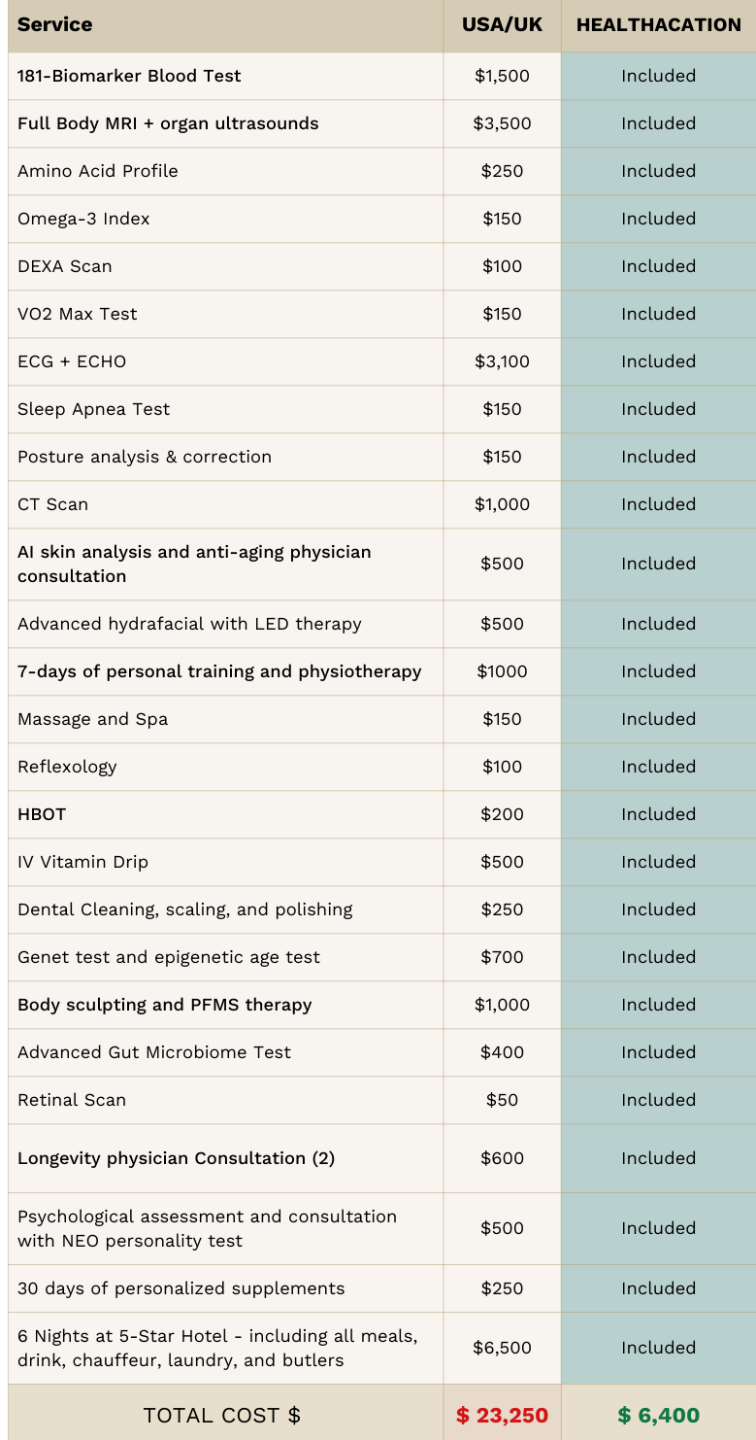
It's basically a full-body, complete health checkup plus consultation with some of the best doctors in India
It's an all-inclusive retreat, which means:
- transportation from the airport to the hotel and back
- 7-day accommodation at the 5-star luxury hotel
- all meals included
- all the tests and bloodwork included
- 180 biomarkers measured via blood test
- any other test and scan you want
- complimentary supplements
Plus, it's a lot of fun to meet like-minded people from across the world.
In our last retreat in January, we had people from South Africa, Argentina, the UK, Vietnam, Australia, Spain, the US, Canada, Finland, and Estonia!
Learn more about it and sign up here: https://www.siimland.co/retreat?cid=cc53c24b-585b-4a44-9539-02d713d7baae
Stay Empowered
Siim
P.S.
We also released a skin anti-aging program that complements the diagnostics program: https://www.siimland.co/retreat?cid=cc53c24b-585b-4a44-9539-02d713d7baae |